Weekend Reading #374

This is the three-hundredth-and-seventy-fourth weekly edition of our newsletter, Weekend Reading, sent out on Saturday 25th July 2026.
To receive a copy each week directly into your inbox, sign up here.
*****
What we're thinking.
Markets are really tricky at the moment with its collective consciousness trying to get its head around AI capex, renewed prospects of the War in Iran and a new Fed regime all at the same time. We had Google upgrade its capex guidance which one would think should reignite the memory names and others than benefit from this gargantuan capex. However, there is also the issue of efficiency of capex spend which has been highlighted by last week's now famous release of Chinese open weight model Kimi K3. A surge in the US dollar has continued, and oil prices have rocketed once again, threatening to revert to the regime we saw at the peak of the war in March. As ever there are loads of variables of increasing complexity and once again, we reiterate this is not a time to get too clever.
What we're meme-ing.
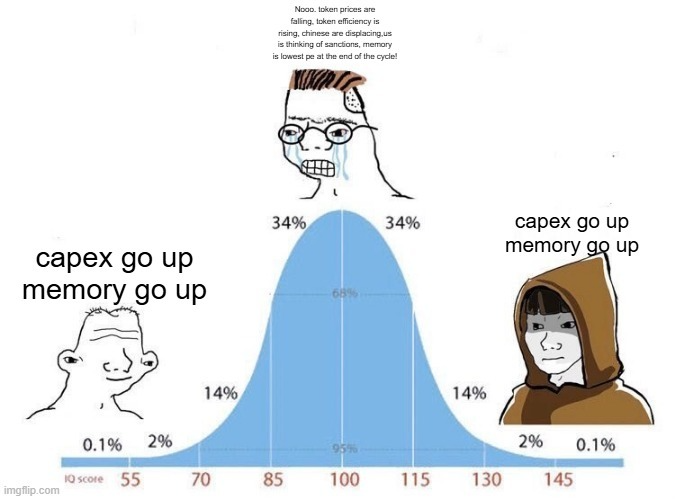
We think it is obvious that rising AI capex is good for memory names but maybe we are wrong. Nevertheless, we put this together this week just for fun.
What we're watching and listening to.
Elon Musk's interview with the economist went viral this week. The section which went viral was 2 minutes of a far longer interview which covered AI and then after that from 1h07m mark onwards politics. This was one of the best interviews I've seen in a long time. The interviewer was excellent. Her views and Elon's are polar opposite and despite some very edgy moments there was little left uncovered. An example of what a real conversation should look like in today's world as they both repeatedly called each other out and then moved on to the next topic. Highly recommend.
Robert Pape has been one of the biggest proponents of the view that Iran is winning the war. He doubles down on this view in his appearance with Steven Bartlett this week in which he warns of bad things coming for both the US and for the global economy. His views are alarmist to say the least but in a matrix of possible outcomes they are worth inputting into the mix. He is adamant that oil prices are about to erupt and that the global economy is about to enter a near-irreparable quagmire. Markets themselves are reacting in that oil prices are rising once again, so there is a chance he could be correct. Well worth a watch.
On the AI front this week, Steve Hou is an analyst who specializes in token pricing. He appeared on the Forward Guidance pod this week to explain exactly what token pricing means and the variables that go into it. This is essential listening to understand what is happening right now in regard to the proliferation of Chinese open weight models and their impact on AI capex and the evolution of the sector going forward.
And finally on crypto, there is has been much back and forth regarding the forthcoming Clarity Act, which will finally regulate crypto tokens (not the same as AI tokens!) and allow transparency for both builders and investors in the space. It has been a long haul, and the bill is not ready just yet, but it is certainly coming and in our view will unleash a flood of innovation and risk taking the crypto space. Maybe not immediately. Or maybe even immediately. This lack of progress on the regulatory front has held back the sector and hopefully we are at a new dawn. Multicoin head of legal, Greg Xethalis, provides his view on its importance and what it unlocks in this episode of the Empire pod. DC
I came across this podcast featuring the highly controversial Graham Hancock, once again talking through his thesis about there being a missing civilisation before the beginning of civilisation that we currently acknowledge. Whatever one may think of him, he’s definitely committed to his cause, and as he mentioned on the podcast, part of the reason why he chose to do this podcast now was because he was due to have open heart surgery from which he might not return (he survived, fortunately). I suppose it’d hard to disprove some of his theories, and one could easily criticise how his methods are probably not as scientific as they should be, with a fair amount of inconsistency – but the questions he poses are certainly worth pondering because to be fair to him, there aren’t satisfactory answers offered by the current orthodoxy. Just another reminder that things are very likely not what we think they are, and there’s a deep hidden (or forgotten) wisdom that hopefully one day we can rediscover. EL
What we're reading.
Devastatingly I have now come to the end of the existing Red Rising series book. Book 6, Lightbringer is once again world class. At this stage of the attention game, for me to hold attention across six epic books without getting bored is something major. I loved every minute of these books. There is a final 7th one coming next year in all likelihood and I simply cannot wait. In the meantime, I cannot think of a better story to take to the screen. Whether in film or series format, this is the best material I can think of. Maybe the AI will build it. Or maybe I will build it with AI! Proper rollicking fun from start to finish alongside a depth many would find surprising for a series of books of this nature in the sci fi genre. It seems I am not the only one who enjoyed this one as it got 5 stars out of 5 on goodreads across over a hundred thousand reviews. Spectacular. DC
On the topic of pyramids and structures aligned to the cosmos, just as I was wondering how humans just stopped building these great structures, this article about a monument called “Star Axis” came up. Built over 50 years in New Mexico, this is probably the most fascinating contemporary construction of our age – a pyramid/observatory that tracks Polaris throughout the Earth’s 26,000 year gravitational wobble. Perhaps this time though, they should include some sort of guide to describe how things work so that if this gets lost and dug up after a couple of millennia, future generations won’t be left as puzzled about its origins and purpose as we are about the pyramids of Giza and other ancient structures. Or perhaps, that’s the point of it all?
Elsewhere, equally in the realm of making the impossible possible was this announcement I spotted about a commercial launch of a device called PRIMA, a treatment granted European CE classification after showing in clinical trials to be able to restore central vision to patients who lost sight due to age-related macular degeneration. Literally they’re making the blind see again. The concept is straight out of science fiction: a subretinal photovoltaic implant is placed as a receiver for light signals sent by a pair of specialised glasses, that convert light into electrical signals that stimulate the optic nerve, effectively replacing the degraded retina. It even includes a zoom-in function to magnify letters. Could be better than a real eye at this rate. EL