
Weekend Reading #379

This is the three-hundredth-and-seventy-ninth weekly edition of our newsletter, Weekend Reading, sent out on Saturday 29th August 2026.
To receive a copy each week directly into your inbox, sign up here.
*****
What we're thinking.
Further data points in the quest to determine what will happen to AI capex arrived this week in the form of Nvidia which produced sensational results and raised guidance looking ahead. Yet once again, apart from Nvidia, which surged, other AI capex beneficiaries just couldn't get up. Memory, neoclouds, optics, you name it. They have all flattered to deceive pricewise. Not so for the world of crypto which continued to moon after last week's initial boost. Memecoins are back, but is it a flash-in-the-pan or are we going to see a speculative frenzy? Funnily enough, we don't know! But there is quite honestly nothing more fun in all of markets that a crypto bull market. Here’s to hoping!
Good luck out there.
What we're listening to.
Simon Sebag Montefiore is one of my all-time favourite historians because he is politically neutral and writes historical fact rather than a biased perspective in any way. I have read many of his book which are written like fiction and read very nicely indeed. Here he appeared for an absolutely wonderful conversation on the Triggernometry Pod with Konstantin Kisin and Francis Foster. He has a new book about the history of the middle east called The Cauldron which I have queued up to read, and he talks about the key bits in this chat. I cannot emphasize enough how pleasant and refreshing it is to see a conversation like this where there is no virtue signalling, political messaging or grandstanding. It's pure factual history and highly educational. DC
What we're reading.
For cricket fans, a rare and very well-written piece about Indian player, Rishabh Pant, a mercurial batsman and wicketkeeper who simply defies all consensus logic. The title references the Three Body Problem which got me to click of course! This excellent piece writes about how you cannot put his talents into a data box. In a sport where data is everything he is quite simply according to this article, unquantifiable. And his unpredictability is a pleasure to behold. DC
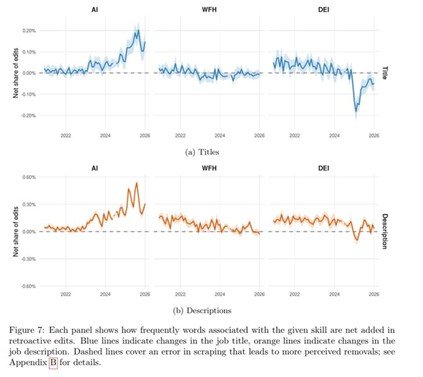
We often get asked why we’re not on LinkedIn, and a large part of it is really to get away from the distasteful sycophancy of social media, even if (or perhaps especially because) done so in the name of “business networking”. This post from Y Combinator’s Paul Graham features this image below from an NBER paper titled “Time Travel on Professional Profiles” which basically sums up how “business” influencers are no less superficial trend chasers than any others. EL
What we're watching.
I am a huge fan of Ricky Gervais. One of the few comedians left on the plant who just calls it like it is and has zero sensitivity to what is these days considered "offensive". He has a new show on Netflix called Alleycats. Short animated episodes featuring a gang of alleycats going about their day-to-day. He voices the main cat, and it is pretty good fun. It is filled with vulgarity and expletives as you would imagine and the incongruousness of it coming out the mouth of animated cats turns out quite well. It's not laugh-on-the-floor type of stuff but there are many good chuckles as well as some pathos in line with his Afterlife series from a few years ago.
For some reason I decided this week to start watching the cult film series, John Wick, with Keanu Reeves. I seem to be the only one I know that hadn't seen it, so I gave it a go. It is pure action and fighting. There is not much else going on to be honest and that was awesome. Apparently, it escalates from here as the films progress too. DC
If you’re looking for an industry that’s been flipped upside down by AI, look no further than the ads on youtube (or Instagram, tiktok and probably every social media platform) – what used to be “trashy” short form video dramas produced by Chinese studios has now become an unending supply of AI-generated ultra-short dramas. And we’re not talking about a “legacy” industry either – this is a relatively new thing, probably not more than 10 years old. Their previous iteration was already “low-cost”: up and coming actors, cast by a Chinese studio, filming dramas with a script that literally makes your brain decay into nothingness, following a recipe book of template plots. Abandoned child goes into the wild and returns trained as a master wizard, billionaire that decided to go anonymous and comes back to pretenders… you get the gist. Probably best described as buzzfeed but with video. Well now thanks to the likes of Seedance and a growing suite of AI video generation tools, the arbitrage on “up and coming actors and actresses” is itself gone – no more actors. Just AI generated voice and video, rolling off a production line. Ragebaiting advertisements that reel you in make you download one of a neverending series of streaming apps, all in the same wireframe format with a different name and logo, offering a small number of episodes for free just to get you hooked, then leaving you with a choice: watch an ad to unlock (sell time for money), or pay to unlock (sell time for money). Pick up a couple of tens of thousands of downloads, sell a couple of $5-20 subscriptions and you’re well in the money. Not to mention there’s no salary bill for cast and crew anymore. This post and the short documentary on it (thankfully not AI, not yet at least) outlines the dilemma facing the hitherto cutting edge of drama production: the ecosystem in Zhengzhou in China, which was one of the country’s film production powerhouses, now faces huge uncertainty amidst the question of whether they remain producers of “old school” drama or pivot to AI production. From producers to directors to cast to crew. The obvious question would be “how much is authenticity worth?” – maybe for a full-scale film, people would still want to see their favourite actors and actresses (or will they?); the middle ground (TV series Netflix-style) might be up for debate too; but for what is effectively the junk food of the video world (meant only as a compliment given how junk food is highly addictive and highly profitable!), how much will the average viewer care about “authenticity”, as long as it “tastes” good? I suppose at the end of the day, no one asks if the potatoes in pringles potato chips are really potatoes. EL